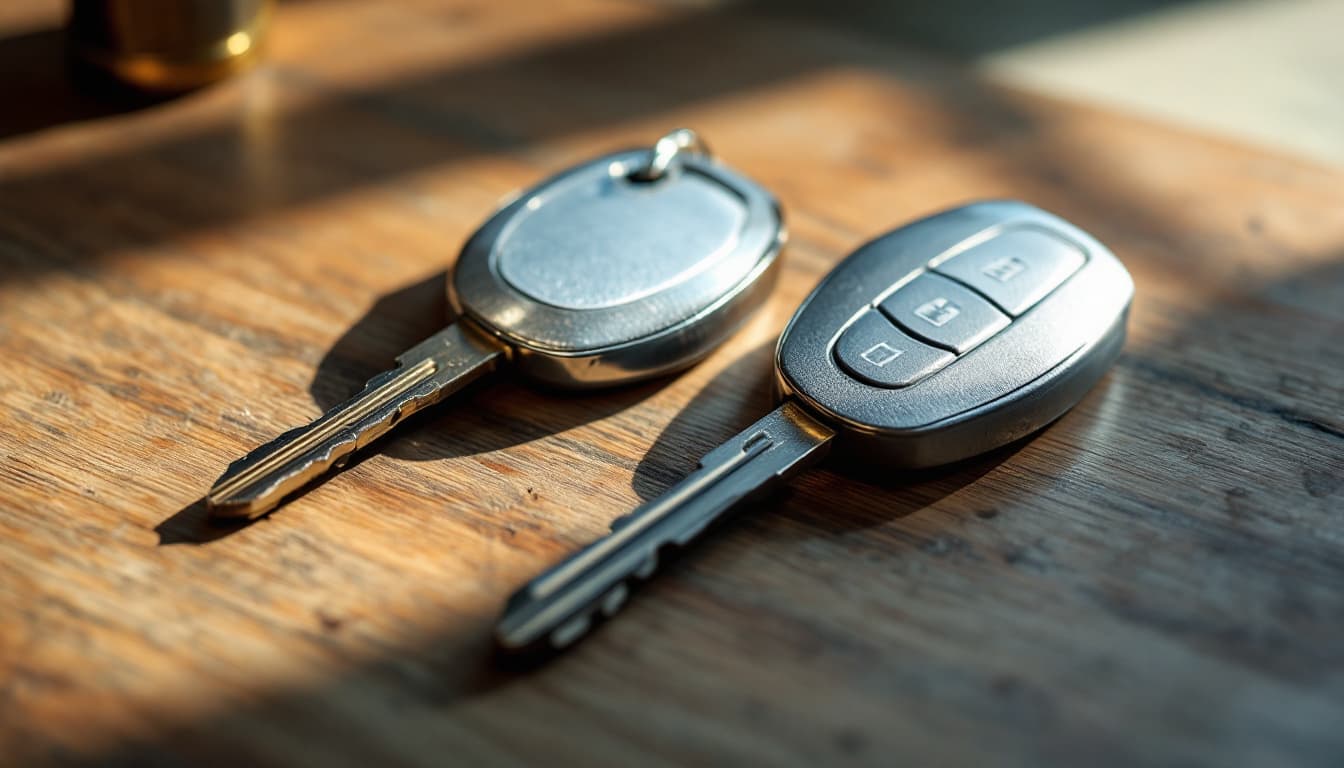
Copied Car Key Unlocks the Doors but Won't Start the Car? (Annetta TX)
A hardware-store or online spare opens the door and turns, but the engine won't run. Why a cut key is not a programmed key, and what it costs in Annetta TX.
Copied Car Key Unlocks the Doors but Won't Start the Car? (Annetta TX)
You had a spare made at a hardware store kiosk, or bought one online, and it looks right. It slides into the door, the lock turns, it goes into the ignition and rotates to start — and the engine cranks and never catches, or fires for two seconds and dies. The security light is flashing at you. This is one of the most common calls we get, and the fix is usually quick. Call or text (817) 813-9396 with the year, make and model and we can normally tell you on the phone what the copy is missing.
Quick Answer
A copied key has two jobs, and the kiosk usually only did one. Cutting the blade makes the key turn the lock. Programming the transponder chip makes the engine allowed to run. If the chip is missing, the wrong type, or never added to the vehicle's immobilizer, the key opens the door and turns the ignition but the car refuses to start. Programming a compatible key usually runs $75 to $150 on site.
Why a Key Can Fit Perfectly and Still Fail
Almost every car, truck and SUV built since the late 1990s has an immobilizer. When you turn the key, an antenna around the ignition reads a small transponder chip hidden in the key head. If the vehicle recognises that chip, it allows fuel and spark. If it does not, the engine either will not fire or starts and shuts off almost immediately.
The metal blade and the chip are completely independent. A kiosk or hardware counter can duplicate the cuts on a standard blade with great accuracy, and the key will turn every lock on the vehicle. What it cannot always do is give that key an identity the car trusts.
That is why this symptom confuses people: the part you can see works flawlessly. The part you cannot see is the part that failed.
The Likely Causes
1. There is no chip at all
Some inexpensive copies are plain metal blanks or aftermarket shells with an empty head. They turn the lock and the ignition and nothing more. On an older vehicle without an immobilizer that is fine; on anything with one, the car will not run. Some shells bought online arrive the same way — the case, the buttons and the blade, but no transponder inside.
2. The chip was cloned, and the clone did not take
Many kiosks work by cloning — copying the data from your original chip onto a new one, so the car thinks it is seeing the original key. Cloning does not touch the vehicle at all. It works well on older, simpler transponder types and much less reliably on encrypted systems. Toyota's H and 8A chips, Chrysler FOBIK keys, later Ford PATS keys and GM's Circle Plus keys are all examples where a clone may be refused, or may appear to work and then fail later.
The clean alternative is programming, where the new key is added to the vehicle's own list of trusted keys with diagnostic equipment. The car then recognises it as a genuinely separate key rather than a copy of another one.
3. The chip is the wrong type for the vehicle
Transponder chips come in many families, and a blank that fits the keyway is not automatically the right electronics. A blade cut perfectly on the wrong chip type gives exactly this symptom. It is especially common with look-alike blanks bought online, where the listing matches the key profile but not the transponder.
4. The remote was programmed but the immobilizer was not
With remote-head keys and fobs, the lock and unlock buttons are programmed separately from the start authorisation. On some vehicles an owner can add remote functions in the driveway; the transponder side still needs to be written to the vehicle. The result is a key whose buttons work, whose blade turns, and which still will not start the engine.
5. A used key locked to another vehicle
Many keys and fobs can only be registered once. A used fob pulled from a salvage yard or sold secondhand may already be locked to the car it came from and will refuse to accept a new registration. Some can be reset or re-used with the right tools; many cannot. If you bought a used key, mention it early — it can save the cost of a failed attempt.
6. The key is fine and the vehicle is not
Less often, the copy is not the problem at all. A failing antenna ring, an immobilizer module fault, or a low battery can all stop a start. That is why the first test below matters so much.
Brand-Specific Patterns We See Around Parker County
Chrysler, Dodge, Jeep and Ram. Earlier models use a transponder key read by the SKIM module; later models use the FOBIK — the rectangular key with a short blade or no blade that plugs into the dash. A FOBIK has to be programmed to the vehicle's security module. Copies bought online are a frequent source of the "buttons work, won't start" call. On the Jeep Cherokee in particular, owners often ask about a copy for the smart key; the details are in the Jeep Cherokee KL spare key guide.
Ford PATS. Ford's Passive Anti-Theft System reads the chip in the key head. On many Ford models an extra key can be added once two working programmed keys are present, and on others it takes diagnostic equipment. A clone that does not match the encryption on newer PATS keys will be refused.
GM. GM has used several systems over the years, from resistor-pellet keys on older models to transponder systems with names like Passlock and Circle Plus. Some generations behave differently when an unrecognised key is tried, so if your copy fails, stop and ask rather than cycling it repeatedly.
Toyota. Toyota's encrypted H and 8A chips are the classic example of a key that clones poorly. A copy that tried to clone one of these may fail outright or work intermittently. Adding a properly programmed key is the reliable route.
What You Can Check Yourself
None of these need tools, and each one narrows the answer.
1. Does the original key still start the car? This is the most important test. If the original starts it normally, the vehicle side is healthy and the problem is the copy. If the original also fails, you are looking at an immobilizer, battery or module problem, and the copy may be innocent. The immobilizer reset and security light guide covers that branch.
2. Watch the security light. Turn the copy to the on position without cranking. With the original key, the security light normally comes on briefly and then goes out. With a rejected copy, it often stays on or flashes. That difference points straight at the chip.
3. Note exactly what the engine does. Cranking but never firing, or starting and dying after a second or two, is the classic pattern of a rejected key. No crank at all points to something else — battery, starter or a gear-selector interlock.
4. Check the blade itself. Is it a plain metal key, or does it have a thick plastic head? A thin, all-metal key on a vehicle from the 2000s or later is almost certainly missing a chip.
5. Be careful about testing it with the original nearby. On some systems, having the original key close to the ignition can let a chipless copy appear to work, because the antenna reads the original instead. On other systems two keys near the antenna can confuse the reading and cause a refusal. Behaviour differs by make, so do not take a result from that test as proof either way.
6. Stop after a few tries. Some systems will lock out for a period, often somewhere in the range of 10 to 15 minutes, after repeated attempts with an unrecognised key. Cycling the ignition over and over can also drain the battery. Two or three tries is plenty.
7. Write down where the key came from. Kiosk, hardware counter, online, used, dealer — the source tells a technician which fix is most likely.
Cut Is Not the Same as Programmed
It helps to know which kind of blade you have, because it affects how the copy is made. A standard key has cuts along its edges; a high-security key has a groove milled into the face of the blade. Kiosks typically handle edge keys well and high-security blades less consistently. The difference is explained in our guide to edge-cut keys and laser-cut keys.
Either way, cutting only solves the mechanical half. The electronic half is a separate step, and it is the step that decides whether the engine runs.
Pricing
As of September 2026, these are the typical ranges for spare-key work in the Annetta, Weatherford and Aledo area. Mobile service is included — we come to where the vehicle is parked.
| Service | Typical price range | Notes |
|---|---|---|
| Program a customer-supplied key or fob | $75–$150 | Only if the key is the correct, compatible type |
| Spare key cut + programmed (transponder) | $95–$175 | Most standard chipped keys |
| Remote-head key or FOBIK supplied + programmed | $150–$275 | Includes the key and the programming |
| Smart / proximity key supplied + programmed | $225–$400 | Push-to-start vehicles |
| Diagnosis if the original key also fails | $95–$180 | Applied toward the repair |
| Mobile call-out | Included | Driveway, work site or parking lot |
| After-hours dispatch | Add-on | Quoted before dispatch, never added after |
Disclaimer: Ranges only. The year, make, model, key type and whether the copy you already own is usable decide the final figure. Call or text (817) 813-9396 before you buy another blank online — we can tell you whether it will work first.
Can the Copy You Already Bought Be Saved?
Often, yes. If the key is the right transponder type for your vehicle and has never been locked to another car, it can usually be programmed on site for the customer-supplied rate above. The blade may also need a re-cut if the kiosk cut was slightly off.
If the key has no chip, the wrong chip, or a used registration that cannot be cleared, it cannot be saved, and a correctly matched key is the cheaper outcome than several failed attempts. We will tell you which one you have before any programming is attempted, so you do not pay for a job that cannot succeed.
Why It Pays to Do This Before You Lose a Key
Adding a second programmed key while you still have a working one is almost always faster and cheaper than an all-keys-lost job, because the vehicle can be accessed with the key you have. The reasoning is laid out in the guide on getting a spare car key cut before you lose the first. A copy that turns but does not start gives you a false sense of security — it will open the door when you are locked out, but it will not get you home.
When to Call a Pro
The original key also fails. That is a vehicle-side problem, and guessing with more keys will not help.
You drive a vehicle with an encrypted system. Toyota H or 8A keys, Chrysler FOBIK, later Ford PATS and GM Circle Plus keys are all better programmed than cloned.
You bought the key or fob online or used. Call first; we can check whether that part number is programmable for your vehicle.
The security light keeps flashing after a few tries. Stop, let the vehicle rest, and have it checked before the battery is drained.
You are in a hurry. Programming happens where the car sits, anywhere across Annetta, Weatherford, Aledo, Willow Park, Hudson Oaks, Benbrook and west Fort Worth.
Frequently Asked Questions
Why does my copied key unlock the door but not start the car?
Because the blade and the transponder chip are separate. The cuts on the blade are what turn the locks, and a kiosk can copy those accurately. Starting requires a chip the vehicle's immobilizer recognises. If the copy has no chip, the wrong chip, or a chip that was never added to the vehicle, the engine will crank or start briefly and then refuse to run.
Is cloning a key the same as programming it?
No. Cloning copies the data from your original chip onto a new one, so the car believes it is seeing the original key, and it never touches the vehicle. Programming adds the new key to the vehicle's own list of trusted keys with diagnostic equipment. Cloning works on many older systems but is less reliable on encrypted keys such as Toyota H and 8A, Chrysler FOBIK, later Ford PATS and GM Circle Plus.
Can you program a key I bought online?
Often, yes, if it is the correct transponder type for your vehicle and has not already been locked to another car. Programming a compatible customer-supplied key typically runs $75 to $150. If the key has no chip, the wrong chip, or a registration that cannot be cleared, it cannot be programmed, and we will tell you that before any work is attempted.
Will trying the copy over and over damage anything?
It will not usually damage the vehicle, but some systems lock out for a period after repeated attempts with an unrecognised key, and each crank uses battery power. Two or three tries is enough to learn what you need. After that, stop and have the key checked.
How much does a working spare key cost in Annetta?
A spare transponder key cut and programmed typically runs $95 to $175, a remote-head key or FOBIK $150 to $275, and a smart or proximity key $225 to $400. Mobile call-out is included, and any after-hours add-on is quoted before dispatch.
Do I need to bring the car to you?
No. Key cutting and programming happen where the vehicle is parked, anywhere in Annetta, Weatherford, Aledo, Willow Park, Hudson Oaks, Benbrook, Fort Worth and the surrounding Parker County area, including the 76008 ZIP code.
Turn the Copy Into a Key That Starts the Car
Have the year, make and model ready, plus where the copy came from and whether your original still starts the vehicle. Call or text (817) 813-9396 for mobile spare-key programming across Annetta, Weatherford, Aledo, Willow Park, Hudson Oaks, Benbrook and Fort Worth.
Article written by the Annetalocksmith Automotive Locksmith Team. Reviewed by a working automotive locksmith technician.