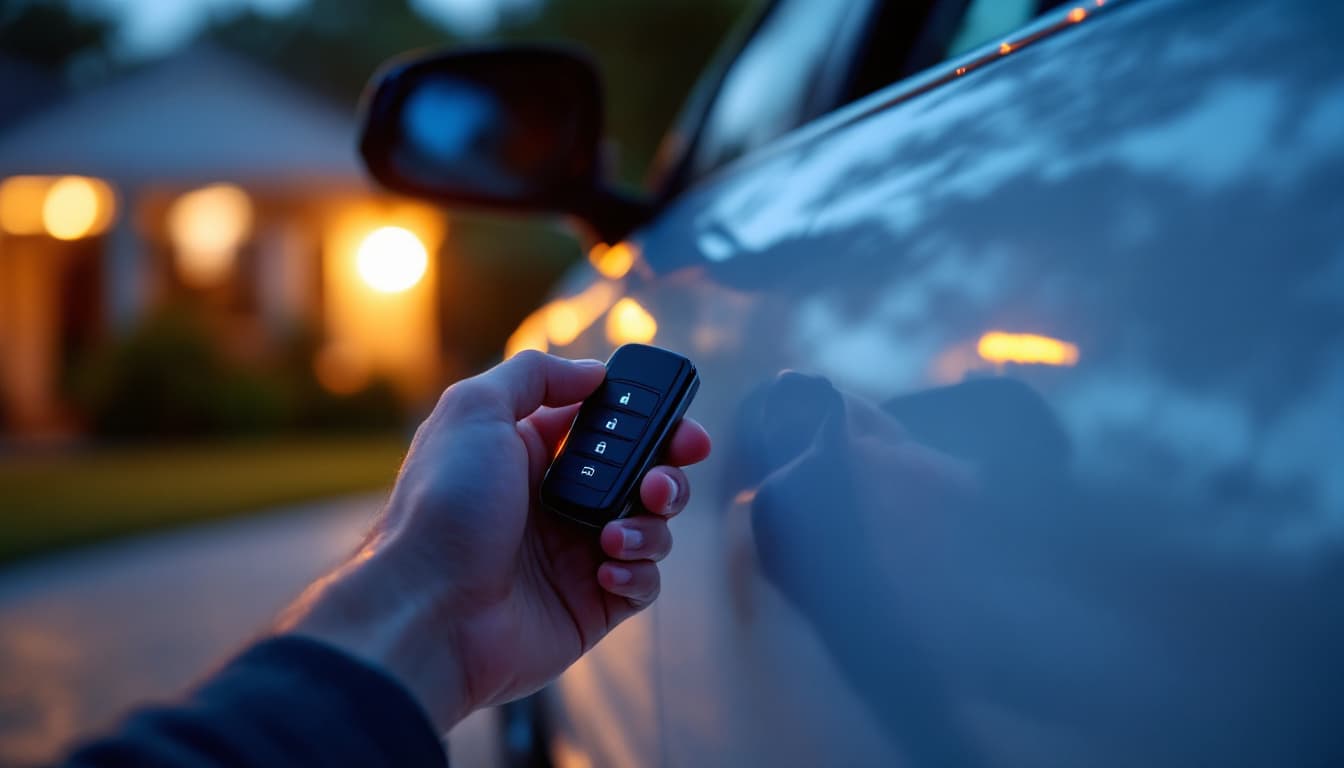
Fob Buttons Work But the Car Will Not Start — Annetta TX
The doors unlock and the trunk pops, so the key must be fine — except the car will not start. Why the remote and the immobilizer are two separate systems, how to tell which half failed, and what the repair costs in Annetta TX.
Fob Buttons Work But the Car Will Not Start — Annetta TX
The remote unlocks the doors, the trunk pops, the lights flash — so the key is obviously fine, and the problem must be the car. That conclusion is wrong often enough to be worth a page of its own. Call or text (817) 813-9396 and we can usually tell you which half has failed over the phone.
Quick Answer
There are two separate systems inside that one piece of plastic. The remote half transmits on a radio frequency to lock and unlock. The security half answers a challenge from the vehicle to authorise starting. They use different electronics, different power paths and different antennas. Working buttons prove the remote half is alive and say nothing whatsoever about the start authorisation. Diagnosis is $80 to $150 in the Annetta area and applies toward the repair.
The One Thing Worth Understanding
Press the unlock button and the fob actively transmits a coded radio signal. The vehicle's receiver hears it and unlocks. That is a one-way broadcast, and it is powered by the fob's own battery.
Starting is a different conversation. The vehicle asks a question and the key has to answer correctly — a challenge and response, using a transponder credential rather than the remote's radio link. On a bladed key that credential sits in a chip read by an antenna ring encircling the ignition lock. On a push-button car it is a passive exchange with the fob when it is detected inside the cabin.
So the two halves can fail independently, and routinely do. A dead transponder chip with a perfectly healthy remote board is a real and common failure. So is the reverse — a car that starts fine from a key whose buttons stopped working years ago.
Once you know that, the whole symptom stops being mysterious: the buttons are not a test of the key.
What Causes It
1. The transponder chip has failed (bladed keys)
The chip is a small component in the head of the key. Dropped keys, keys that have been through the wash, keys that have spent eight years in a pocket — the chip or its tiny antenna coil cracks, and the vehicle gets no answer. A replacement transponder key runs $120 to $300 programmed on site.
The tell: the security or immobilizer light behaves differently with this key than with your spare, and the engine cranks but will not run — or starts and dies within two seconds.
2. The immobilizer antenna ring has failed
That ring around the ignition lock cylinder is what reads the chip. If the ring or its wiring fails, a perfect key gets no reading. The give-away is that no key works, including a known-good spare — which points at the vehicle rather than the key. Pricing on a ring is quote-only because access varies enormously between platforms.
3. A weak fob battery on a push-button car
This one surprises people. On many smart-key vehicles the button transmission is the stronger function and the passive detection used for starting is the weaker one. A battery on its way out can still fire the lock button from a few feet while failing the low-power exchange the car needs to authorise a start.
Two consequences: a fob test and battery service is $20 to $50 and is the cheapest possible outcome, so it gets tried first. And most push-button vehicles have a documented backup method — holding the fob against the start button or a marked spot on the column — that works with a nearly dead battery. Your owner's manual has the exact procedure for your car, and it is worth knowing before you need it.
If the range has been shrinking for weeks rather than failing suddenly, the key fob range getting shorter guide covers how to tell a dying battery from a dying board.
4. The key lost its registration
A key's credential is registered to the vehicle. That registration can be lost — after immobilizer or body-module work, after a module replacement, and on some platforms after an all-keys-lost procedure re-writes the trusted key list. The remote half often keeps working because it is registered separately in a different module.
This is a data problem, not a hardware problem. Reprogramming an existing fob runs $60 to $150; an immobilizer reset with a key relearn runs $100 to $250.
5. A key that was never fully programmed
Extremely common with fobs bought online, and the cause of a surprising number of these calls. Somebody programmed the remote functions — which on some platforms an owner can do in the driveway — and the transponder credential was never written at all. The result is exactly this symptom: buttons work beautifully, car will not start.
Re-shelled keys are the other version. A new housing with a salvaged board may carry a credential from its original vehicle and refuse to accept a new one. If you bought a fob online, mention it early — it saves everyone a diagnostic loop.
6. The immobilizer module, the body module or the network
The module that runs security has to be powered, grounded and able to talk to the rest of the vehicle. A fault there means the challenge never gets asked, and the vehicle refuses to start regardless of which key you hold.
The pattern that points here: the no-start arrived alongside other unrelated electrical oddities — interior lights, locks, wipers, gauges. That is the signature described in the body control module failure symptoms guide, and it is a module investigation rather than a key one.
7. It is not the security system at all
Worth stating plainly, because it is sometimes the answer: a no-start can be a starter, a battery, a fuel or ignition fault, or a neutral-safety issue. If the security indicator is behaving completely normally and the engine cranks strongly without ever trying to run, the problem may be mechanical.
That distinction is exactly what a diagnosis buys you, and it is the difference between a key purchase and a trip to a mechanic.
Manufacturers Call It Different Things
The concept is universal; the names are not, and knowing yours helps when you search. Ford uses PATS. GM has used Passlock and various theft-deterrent systems. Chrysler, Dodge, Jeep and Ram have run SKIM, SKREEM, and the WIN module — and the Charger and Challenger family has its own programming quirks, covered in the Dodge Charger and Challenger key fob programming page. Nissan uses NATS. Hyundai's is SMARTRA, and that one has enough platform-specific behaviour to deserve the separate Hyundai SMARTRA immobilizer module programming walkthrough.
Different names, same architecture: a credential in the key, a reader in the car, a module that decides.
How to Narrow It Down Yourself in Five Minutes
None of these require tools, and all of them shorten the diagnosis.
1. Try the spare key. The single most useful test there is. If the spare starts it, your first key is the problem — likely the chip. If neither key starts it, the vehicle is the problem.
2. Watch the security light. Turn the ignition on without cranking. A light that comes on and goes out normally suggests the key was accepted. A light that stays on, flashes rapidly, or flashes after the engine dies suggests the credential was rejected.
3. Does it crank? A strong crank that never fires points at security, fuel or ignition. No crank at all points somewhere else entirely — including a range or interlock problem, which is a different fault.
4. Does it start and die in about two seconds? That is nearly always security shutting off the fuel after a failed authorisation.
5. On a push-button car, use the backup position. Hold the fob where your manual says. If it starts that way, you have found a passive-detection problem — often just the battery.
6. Fit a fresh fob battery. Correct type, correct orientation, clean contacts.
7. Write down what changed. New battery, jump start, module work, a fob bought online, a car that sat for months. Timeline is diagnostic data.
What It Costs in Annetta TX
| Service | Typical price range | Notes |
|---|---|---|
| Fob test + battery service | $20–$50 | Cheapest outcome, tried first |
| Reprogram an existing fob or key | $60–$150 | When registration was lost |
| Replacement transponder key | $120–$300 | Chip failure on a bladed key |
| Replacement remote fob | $90–$250 | Programmed on site |
| Replacement smart / proximity fob | $250–$450 | Push-to-start models |
| Immobilizer diagnosis | $80–$150 | Applied toward the repair |
| Immobilizer reset / key relearn | $100–$250 | When data is the problem |
| Vehicle-side diagnosis (receiver, BCM) | $80–$150 | When no key works |
| Antenna ring replacement | Quote | Access varies by platform |
| Module-level immobilizer repair | Quote | BCM or immobilizer box faults |
| Evening, weekend or holiday dispatch | Add-on | Quoted before dispatch, never added after |
Disclaimer: Ranges only. Make, model year, key type and which half has failed decide the figure. Call or text (817) 813-9396 with the year, make, model and what the security light does.
When to Call Rather Than Keep Trying
Neither key starts it. That is the vehicle, and guessing gets expensive.
You are stranded. Especially after dark or on a rural road — this is mobile work and the vehicle does not need towing.
It cranks and dies repeatedly. Each attempt is asking a lot of the battery and, on some engines, fuelling a cylinder that is not firing. Stop after a few tries.
You bought a fob online and programmed the remote yourself. Say so up front; it is a known pattern with a known fix.
The no-start came with other electrical symptoms. That is a module investigation, and it is cheaper to diagnose than to replace parts against.
A mobile diagnosis is $80 to $150 applied toward the repair, and it happens wherever the car sits — driveway, pasture gate, parking lot in Weatherford, job site in Aledo. If the answer turns out to be mechanical rather than security, you get that in writing so no one pays twice to find the same fault.
Frequently Asked Questions
Why do my fob buttons work if the key is bad?
Because the fob contains two independent systems. The remote half transmits a radio signal to lock and unlock, powered by the fob battery. The security half answers a challenge from the vehicle to authorise starting, using a separate transponder credential. Either can fail while the other keeps working, so working buttons are not a test of the key.
The doors unlock but the car cranks and dies in two seconds. What is that?
That is almost always the immobilizer rejecting the key's credential and shutting off fuel after the engine briefly runs. The likely causes are a failed transponder chip, a failed antenna ring at the ignition, or a key whose registration was lost or never completed.
Could it just be the fob battery on a push-button car?
Yes, and it is the first thing to rule out. On many smart-key vehicles the passive detection used for starting needs more from the battery than the lock button does, so a weak battery can leave the buttons working while the start fails. A fob test and battery service is $20 to $50. Most push-button cars also have a backup start position described in the owner's manual.
I bought a fob online, programmed the remote, and now it will not start the car. Why?
Because the remote functions and the transponder credential are programmed separately. On some platforms an owner can add remote functions in the driveway, but the credential that authorises starting must be written to the vehicle with professional equipment. Re-shelled fobs carrying a salvaged board can also refuse to accept a new credential entirely.
How do I tell whether it is the key or the car?
Try your spare. If the spare starts it, the first key has failed. If neither key starts it, the fault is on the vehicle side — commonly the antenna ring, the immobilizer module, a power or ground problem, or the data network. That single test saves the most diagnostic time.
Do you come out, or do I need a tow?
We come to the vehicle. Key programming, immobilizer relearns and on-site diagnosis all happen where the car is parked, anywhere in Annetta, Weatherford, Aledo, Willow Park, Hudson Oaks, Benbrook, Fort Worth and the surrounding Parker County area. A no-start almost never needs a tow to be resolved.
One Phone Call Sorts the Key From the Car
Have the year, make and model ready, plus what the security light does and whether your spare key works. Call or text (817) 813-9396 for mobile diagnosis and key programming across Annetta, Weatherford, Aledo, Willow Park, Hudson Oaks, Benbrook and Fort Worth.
Article written by the Annetalocksmith Automotive Locksmith Team. Reviewed by a working automotive locksmith technician.