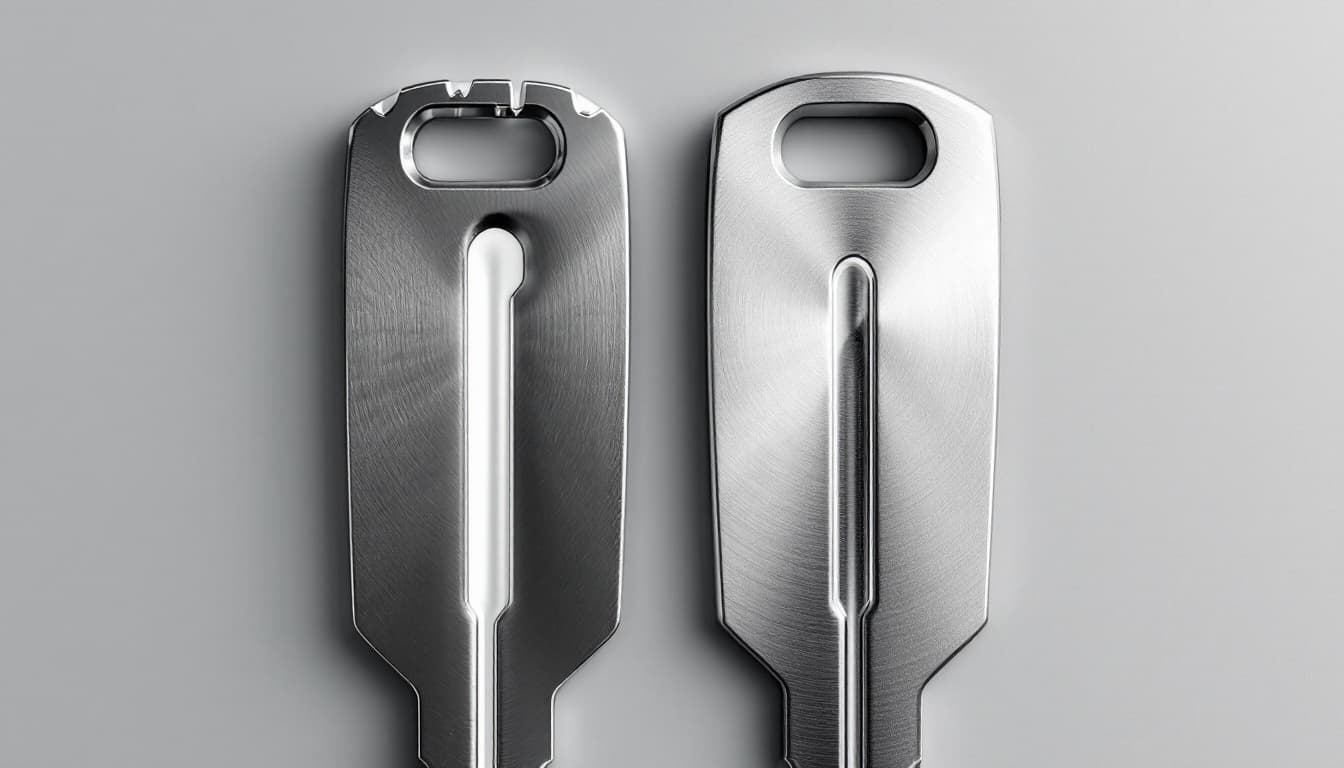
Laser-Cut vs Edge-Cut Car Keys (Smooth vs Regular) — Annetta TX
Smooth-edged laser-cut keys vs regular edge-cut keys, explained for Annetta TX drivers. Why sidewinder keys cost more, which cars use each type, why kiosks can't copy them, and what duplication really costs.
Look at your car key's blade. If the teeth are cut into the edges like a jagged mountain range, that's an edge-cut key. If the blade is thick and smooth-edged with a winding groove milled down the middle of the face, that's a laser-cut key — also called a sidewinder. The difference decides where you can get it copied, how much it costs, and how secure your car is. Call or text (817) 813-9396 for either kind, cut and programmed on-site in Annetta, Weatherford, Aledo or Fort Worth.
Quick Answer: The Two Cutting Styles
Edge-cut keys — what most people mean by a "regular" or "normal" car key — carry their code as notches along the blade's edge. Traditional style, cut on common duplicators, used on most older and many economy vehicles. Laser-cut keys, also called sidewinder or "smooth" keys because the edges are smooth instead of jagged, carry the code as a milled channel down the center of a thicker blade, cut on a specialized milling machine that ordinary hardware stores and kiosks don't have.
So if you have been searching for "smooth cut key versus regular key", those are the two things you are comparing. Laser-cut keys resist picking better, work inserted either way up, and cost more to duplicate — and on nearly all modern cars, both styles also contain a transponder chip that must be programmed. As of September 2026, an edge-cut transponder key in the Annetta area runs $120 to $250 and a laser-cut one runs $150 to $300.
Key Duplication Pricing in Annetta TX
| Key type | Typical Price Range | Notes |
|---|---|---|
| Edge-cut, no chip (older cars) | $25–$60 | Cut only |
| Edge-cut transponder key | $120–$250 | Cut + programmed |
| Laser-cut transponder key | $150–$300 | Milling + programming |
| Laser-cut smart-fob emergency blade | $40–$90 | Blade only, fob exists |
| All keys lost (either style) | $200–$500+ | Code recovery included |
Disclaimer: Ranges only — the vehicle decides the blank, the machine time, and the programming. Call or text (817) 813-9396 with year, make, and model.
How to Tell Which Key You Have
Edge-cut
Thin blade, visible teeth along one or both edges, often shiny wear on the tips. Fits most pre-2010s economy and mid-range vehicles, plenty of trucks, and many current base models.
Laser-cut / sidewinder
Noticeably thicker, blunter blade with smooth edges and a snake-like groove milled into the flat face — usually on both sides, so it works inserted either way. Common on European makes for decades, and widespread now across Japanese, Korean, and American brands, especially on emergency blades hidden inside smart fobs.
Why Laser-Cut Keys Cost More
The machine
A sidewinder groove is milled, not clipped. The cutting machine is a small CNC mill with alignment fixtures — a serious equipment investment, which is why the kiosk at the grocery store and most hardware counters simply can't duplicate one.
The precision
Center-milled channels leave less room for sloppy tolerances than edge notches. A slightly-off copy of an edge key often still works; a slightly-off sidewinder binds. Good duplication starts from the factory key code where possible, not from tracing a worn original.
The blank
Thicker high-security blanks cost more than standard brass, and many are model-specific.
The Part Everyone Forgets: the Chip
Cutting is half the key. Nearly every vehicle from the mid-2000s on — edge-cut or laser-cut — has a transponder chip in the head that must be programmed to the car's immobilizer, or the perfectly-cut copy will open the door and then refuse to start the engine. This is the most common reason a cheap copied key "doesn't work": it was cut but never programmed. A mobile locksmith does both in one visit, in your driveway.
Security: Does Laser-Cut Actually Matter?
Yes, meaningfully. The milled keyway is harder to pick and the blank harder to obtain, which raises the effort for physical attacks. But on any modern car the transponder immobilizer is the real theft barrier — a would-be thief with a perfectly cut blade and no valid chip still can't start the engine. The combination — high-security cut plus programmed chip — is what modern vehicles rely on.
A Recent Example of Why the Cut Matters
A customer near Willow Park brought us a laser-cut key that a big-box kiosk had produced for a late-model sedan. It went into the ignition and turned, so it looked like a win — but the milled channel was shallow by a fraction of a millimeter, and the key worked in the doors and refused the ignition about one attempt in four. That intermittence is the classic signature of a marginal cut rather than a programming fault.
Cutting a fresh blade to the vehicle's own code rather than copying a worn original fixed it in twenty minutes. If a new key works "most of the time", stop using it — a key that binds is also a key that snaps, and then you are paying for extraction on top of everything else.
Which Makes Went Laser-Cut Early
The question behind most “why is my key expensive” calls is really which side of this line the vehicle falls on. As a rough guide as of September 2026: the domestic luxury brands moved to side-milled blades earlier than their mainstream siblings, which is why a Cadillac key is priced differently from a comparable-year Chevrolet key — the Cadillac key replacement cost breakdown shows that split by generation. European vans and cars have used high-security profiles for a long time, and most push-button vehicles hide a laser-cut emergency blade inside the fob even though the blade never goes near the ignition.
The practical version: if the blade has a channel milled into the flat face rather than notches on the edge, it is the more expensive blank and it needs the milling machine. The VIN answers it definitively before anything is cut.
Frequently Asked Questions
Why wouldn't the hardware store copy my key?
If it's a laser-cut sidewinder, they likely don't have the milling machine — most duplicators only handle edge-cut blanks. If it's chipped, they may cut it but can't program it. A mobile automotive locksmith carries both the mill and the programmer.
My copied key opens the door but won't start the car. Why?
The cut is fine; the chip isn't programmed (or the blank had no chip at all). Programming it to your car's immobilizer finishes the job — bring the copy and we can often salvage it.
Are laser-cut keys stronger than edge-cut keys?
Generally yes — the blade is thicker and the smooth edges leave more metal in cross-section. They still break at worn hinges and shoulders like any key, so a cracked key deserves replacing before it snaps.
Can you cut a laser key from the code if mine is too worn to copy?
Yes — cutting from the vehicle's factory key code produces a like-new key instead of cloning the wear of the old one. It's the right call for any badly worn key, either style.
Do you cut both types on-site?
Yes — edge duplicators and sidewinder milling equipment ride in the van, along with the programmer. One visit covers cut plus chip across Annetta, Willow Park, Hudson Oaks, Benbrook, Fort Worth and Parker County.
Which style does my car take?
The vehicle decides, and the VIN answers it before anyone is dispatched. As a rough guide, most pre-2010 economy cars and a great many trucks use edge-cut blades, while European makes moved to laser-cut decades ago and Japanese, Korean and American brands followed — particularly for the emergency blade hidden inside a smart fob. On older commercial vans the answer can be neither of the obvious ones: the T1N Sprinter pairs a cut blade with an infrared transmitter, which is a third arrangement entirely.
Get the Right Key, Cut Right, the First Time
Whether your car takes a simple edge blank or a high-security sidewinder, the job isn't done until the cut is precise and the chip is programmed. Call or text (817) 813-9396 and we'll do both at your location, anywhere in Annetta and Parker County.
Article written by the Annetalocksmith Automotive Locksmith Team. Reviewed by a working automotive locksmith technician.