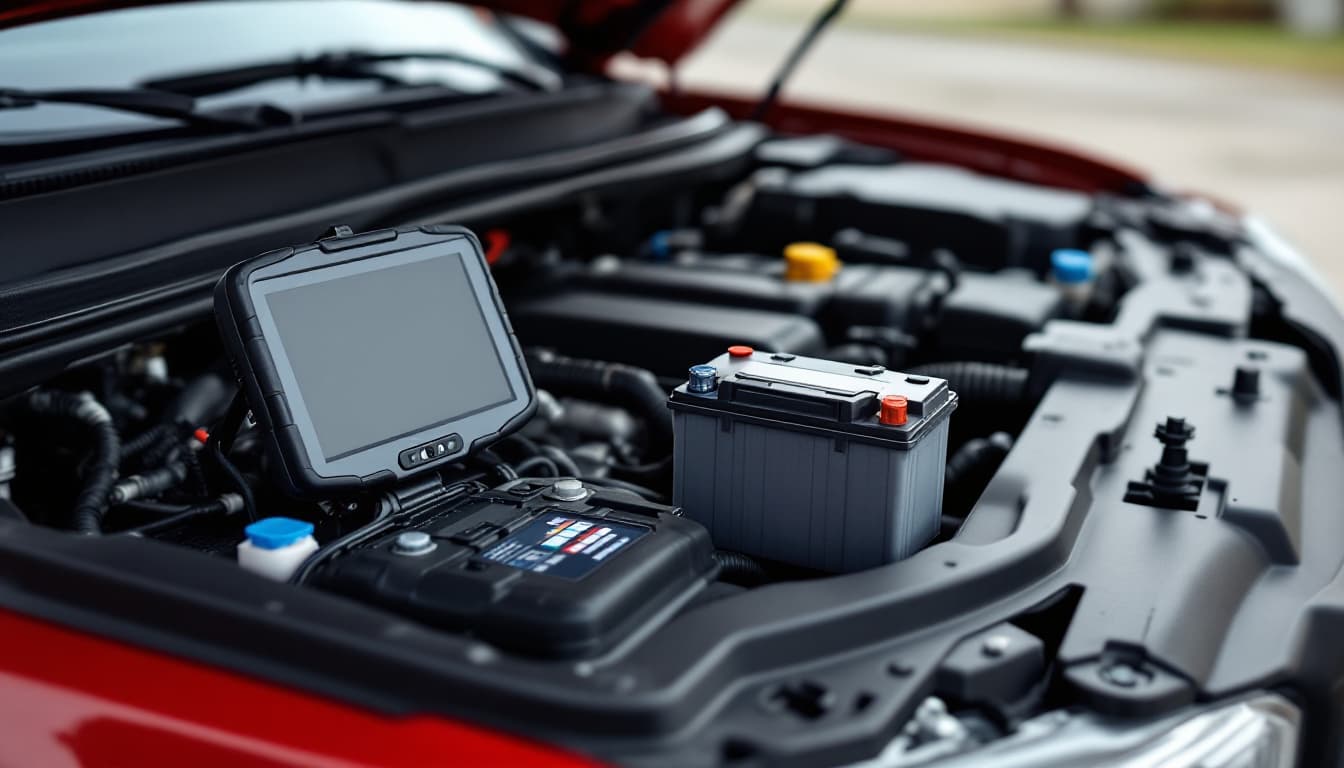
Transmission Shifts Hard After a Battery Change or Disconnect (Annetta TX)
New battery, and now the automatic bangs into gear, flares or hunts? Why learned shift values reset, when a relearn fixes it, and costs in Annetta TX.
Transmission Shifts Hard After a Battery Change or Disconnect (Annetta TX)
The truck needed a new battery, or it sat in the barn until the old one went flat, or someone disconnected the terminals to work on something else. Now the automatic bangs into second, flares between gears, hunts back and forth on the highway, or a light has come on that was not there before. It is an unsettling feeling, and it is often less serious than it seems. Call or text (817) 813-9396 and we can help you work out whether it needs time, a relearn, or real programming.
Quick Answer
Modern automatics learn how your particular transmission behaves and store those adjustments in the transmission control module. Losing battery power, or a low-voltage event, can wipe those learned values, so the transmission shifts on default settings and feels harsh until it relearns. Many vehicles relearn on their own over normal driving. Some need a scan-tool relearn, which runs $75 to $200. Reprogramming is only needed when the module itself lost its software.
Why a Battery Change Affects the Transmission
An automatic transmission is controlled by a computer, the TCM (transmission control module), sometimes built into the engine computer and sometimes separate. It decides when to shift and controls the clutches inside the transmission through electrically operated solenoids.
No two transmissions wear exactly the same. Clutch packs settle, fluid ages, tolerances drift. To keep shifts smooth, the TCM constantly measures how long each shift actually takes and adjusts clutch pressure to compensate. Those corrections are called adaptive values or learned values, and they are what make a five-year-old truck shift as smoothly as a new one.
On many vehicles those values are kept in memory that depends on a steady power supply, and on others a voltage disturbance can corrupt them. Either way, after a battery event the TCM may go back to factory defaults — values written for an average transmission, not yours. The result is shifts that are firmer, slower or less consistent than you are used to.
That is the normal case, and it usually cures itself. The less common cases are what this guide helps you separate.
The Likely Causes
1. Learned shift values were reset (most common)
This is the everyday explanation. Nothing is broken; the transmission has simply forgotten how it likes to shift. Symptoms are firm or clunky shifts, occasional flares, and a slightly different feel at light throttle, with no warning light. It usually improves steadily over the following days of driving.
2. The platform needs a scan-tool relearn
Some transmissions relearn well on their own. Others adapt slowly, or need a procedure run from diagnostic equipment to relearn properly. Three families we work on often around Parker County:
Ram 1500, Jeep Grand Cherokee and other 8-speed models. Many of these use the ZF-designed 8-speed automatic, sometimes called the 8HP. After a power loss, a transmission adaptation run with a scan tool is often recommended to restore smooth shifting rather than waiting for it to relearn slowly.
Chevy Silverado and GMC Sierra. The 6L80 six-speed and 8L90 eight-speed automatics both have a fast-learn type procedure available through GM-capable diagnostic software. Owners of the 8-speed in particular tend to notice harshness after a battery event.
Ford F-150. The 10R80 ten-speed, and the older 6R80 six-speed, store adaptive values that can be reset and relearned. After a reset, the truck may feel busy or abrupt for a while, and a guided relearn can shorten that period.
The exact procedure varies by model year and software level, which is why it is done with equipment that reads the specific vehicle rather than by a generic set of steps.
3. A low-voltage event set codes or disturbed a module
A dying battery, a poorly done jump start, or reversed jumper cables can create voltage dips and spikes. Modules can log communication codes, and some may behave strangely until the codes are cleared and the system is checked. If other warning lights appeared at the same time, or other electronics are acting up, this is a likely piece of the story. The patterns described in our guide to BCM failure symptoms often show up alongside it.
4. The TCM lost its programming (rare)
Occasionally a module does not just lose its learned values but loses or corrupts its actual software. That tends to show up as a hard fault: a warning light, the transmission stuck in one gear, no communication with a scan tool, or a vehicle that will not shift at all. That is a reprogramming job, not a relearn, and it is covered in detail in our page on transmission software programming.
5. A mechanical problem that happened to show up now
Sometimes the timing is a coincidence. Low or burnt fluid, a failing solenoid, or internal wear can all cause harsh shifts, and a battery change may simply have been the moment someone started paying attention. If the relearn does not fix it, or the symptoms are severe, a transmission specialist needs to look at it. We will tell you plainly when it is mechanical and refer you on, rather than selling programming that cannot fix it.
What You Can Check Yourself
1. Give it a normal drive cycle. Drive the vehicle gently and normally for several days: a mix of in-town stop-and-go and steady highway speed, with light to moderate throttle, letting it reach full operating temperature each trip. Avoid hard launches while it is relearning. Many vehicles smooth out noticeably within this time.
2. Check the battery and terminals. A new battery installed with loose or corroded terminals can cause intermittent voltage problems that look like transmission trouble. Clean, tight terminals are the first thing to confirm. If you have a meter, a healthy battery at rest normally reads roughly 12.6 volts, and around 13.5 to 14.5 volts with the engine running.
3. Scan for codes. Many parts stores will read codes, or you can use an inexpensive reader. A clean scan with harsh shifting points toward a simple reset. Transmission, communication or voltage codes point toward a closer look.
4. Note exactly what it does. Harsh on the first few shifts only, or all the time? Flaring on the 2-3 upshift? Hunting on the highway? Delayed engagement into drive or reverse? These details tell a technician a great deal.
5. Write down what happened to the battery. Replaced, jumped, disconnected for other work, or went dead while parked — and for how long. That timeline is diagnostic information.
When to Stop Driving
Some symptoms mean the vehicle should be parked until it is checked:
It is in limp mode. The transmission stays in one gear, often second or third, with a warning light. That is the module protecting itself.
It slips. Engine speed rises without the vehicle speeding up to match.
There is no reverse, or no drive. Do not keep trying to force it.
Fluid is leaking or smells burnt. That is mechanical and needs a transmission shop.
In any of these cases, do not wait for a relearn to fix it. Get it scanned first.
Relearn, Reprogramming, or a Repair Shop?
It helps to know the three tiers, because they cost very different amounts.
A relearn resets and re-teaches the adaptive values on a module whose software is intact. It is the cheapest fix and the most common one after a battery event.
Reprogramming writes software or a calibration update to the module, either the existing one or a new or remanufactured unit that must be matched to your vehicle identification number. That is a bigger job, explained in the broader guide to ECM computer programming and costed out in the TCM programming cost guide.
Mechanical repair is for fluid, solenoids and internal parts. That is outside what a mobile programming service does, and we will refer it out.
If the vehicle also shows the wrong gear on the dash after the battery work, that is a related symptom with its own diagnosis, covered in dash shows wrong gear. And if the battery change caused a no-start rather than a harsh shift, see car won't start after battery replacement.
Pricing
As of September 2026, these are the typical ranges for this work in the Annetta, Weatherford and Aledo area. Mobile service is included.
| Service | Typical price range | Notes |
|---|---|---|
| Diagnosis | $95–$180 | Applied toward the repair |
| Adaptive reset / relearn procedure alone | $75–$200 | Software intact, values lost |
| TCM calibration update on existing module | $150–$350 | When a newer calibration applies |
| TCM programming to VIN + calibration (new or reman) | $150–$350 | Module supplied separately or sourced |
| Full program + relearn package | $250–$500 | Programming plus the adaptation |
| Mobile call-out | Included | Driveway, ranch or work site |
| After-hours dispatch | Add-on | Quoted before dispatch, never added after |
Disclaimer: Ranges only. The year, make, model, transmission and what the scan shows decide the final figure. Mechanical transmission repair is not included and is referred to a transmission specialist. Call or text (817) 813-9396 with the year, make and model and a description of the shift.
When to Call a Pro
It has not improved after several days of normal driving. The vehicle may be one that needs a scan-tool relearn.
There are codes or a warning light. That moves it past a simple reset.
You drive an 8-speed Ram, Jeep or GM truck, or a 10-speed F-150. These respond well to a guided relearn, and waiting can mean weeks of harsh shifting.
The module will not communicate or the transmission is stuck in one gear. That points to a programming problem.
You are not sure whether it is safe to drive. A diagnosis answers that before you head onto Interstate 20.
We come to the vehicle anywhere across Annetta, Weatherford, Aledo, Willow Park, Hudson Oaks, Benbrook and west Fort Worth, and a diagnosis is applied toward whatever the fix turns out to be.
Frequently Asked Questions
Why does my transmission shift hard after a new battery?
Because the transmission control module stores learned shift adjustments that fine-tune clutch pressure for your specific transmission. A battery disconnect or low-voltage event can reset those values to factory defaults, so the transmission shifts on generic settings and feels harsh or inconsistent until it relearns.
Will the transmission relearn on its own?
Many will, over several days of normal, gentle mixed driving with the vehicle fully warmed up. Some platforms relearn slowly or benefit from a scan-tool procedure, including many 8-speed Ram, Jeep and GM trucks and the Ford 10-speed. If it has not improved after a few days, a guided relearn is the next step.
How much does a transmission relearn cost?
A relearn procedure on its own typically runs $75 to $200, and diagnosis runs $95 to $180 applied toward the repair. If the module needs a calibration update or programming, that usually runs $150 to $350, and a full program plus relearn package runs $250 to $500. Mobile call-out is included.
Is it safe to drive with harsh shifts after a battery change?
Mild firmness with no warning light is usually safe to drive gently while it relearns. Stop driving and have it checked if the transmission is stuck in one gear, slips, has no reverse or drive, leaks fluid, or smells burnt. Those are signs of a more serious problem.
Can a jump start damage the transmission computer?
It can in some cases. A bad jump start, reversed cables or voltage spikes can set codes or disturb modules, and rarely corrupt a module's software. Most of the time the result is lost learned values rather than damage, but a scan will show whether anything more happened.
Do you fix mechanical transmission problems?
No. We handle diagnosis, relearns and transmission module programming at the vehicle. If the problem turns out to be fluid, solenoids or internal wear, we tell you that clearly and refer you to a transmission specialist so you do not pay for programming that cannot fix it.
Get the Shift Back to Normal
Have the year, make and model ready, plus what happened to the battery and how the transmission is behaving. Call or text (817) 813-9396 for mobile transmission diagnosis, relearns and programming across Annetta, Weatherford, Aledo, Willow Park, Hudson Oaks, Benbrook and Fort Worth.
Article written by the Annetalocksmith Automotive Locksmith Team. Reviewed by a working automotive locksmith technician.