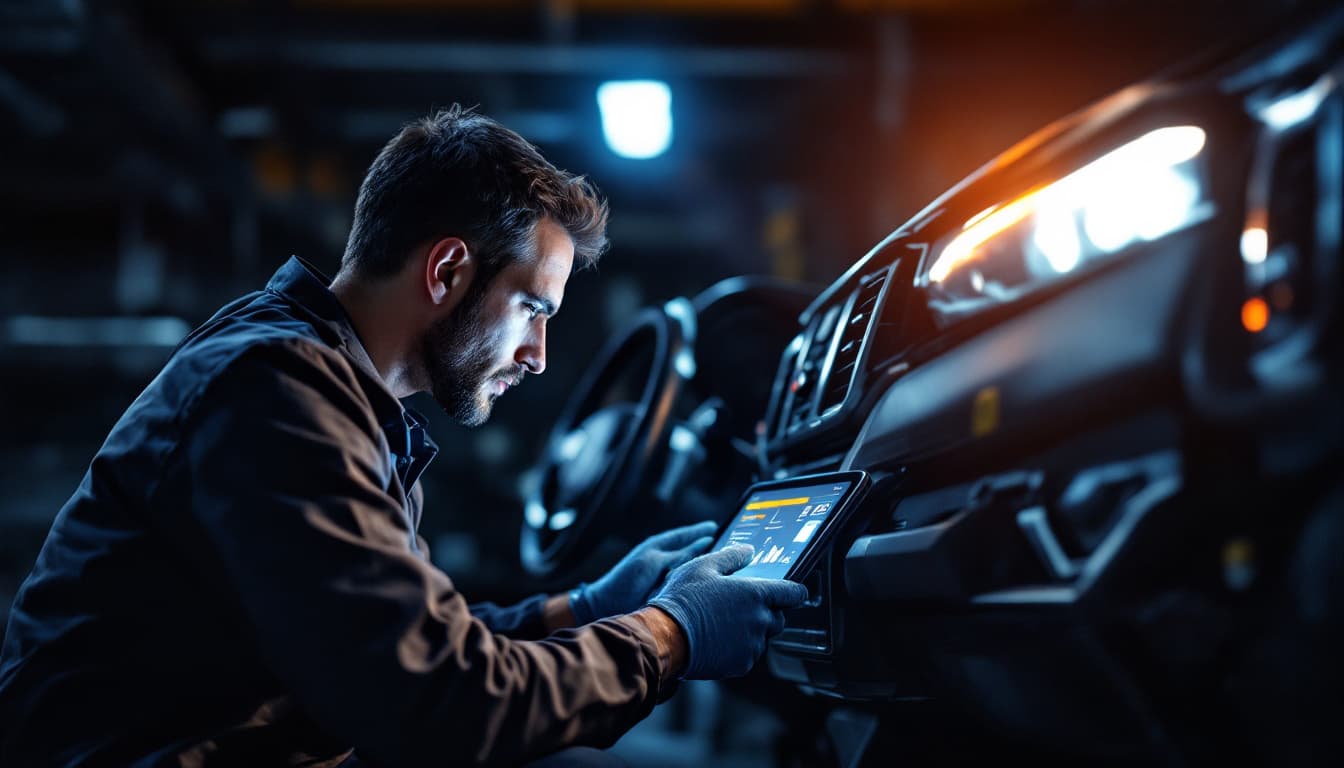
Dodge Durango RF Hub & Immobilizer Module Programming — Annetta TX
Dodge Durango module programming in Annetta TX. What the RF hub does, why a replaced module must be married to the VIN, and how all-keys-lost differs from a module fault.
There's a specific kind of Durango problem that eats money: the SUV cranks fine, fires for a beat, and dies — and the owner has already bought two key fobs trying to fix it. The keys were never the problem. The module that reads them was. Call or text (817) 813-9396 for Durango module diagnosis and programming in Annetta, Weatherford, Aledo and Fort Worth.
Quick Answer
The RF hub (radio-frequency hub module) on a modern Durango is the component that listens for your key fob, verifies it, and tells the powertrain it's allowed to run. When it fails or gets replaced, no amount of new keys will help until the module itself is programmed and married to the vehicle's VIN. A mobile automotive locksmith with the right diagnostic equipment can distinguish a module fault from a key fault at your driveway — and that distinction is the difference between a $250 problem and a $2,000 one.
Durango Module Programming Pricing in Annetta TX
As of July 2026, typical Parker County ranges:
| Service | Typical Price Range | Notes |
|---|---|---|
| Immobilizer diagnosis (key vs. module vs. wiring) | $85–$160 | Applied toward the repair |
| RF hub programming to VIN (module supplied) | $250–$500 | Marry module + relearn keys |
| Key relearn after module work | Included | All existing fobs re-registered |
| All keys lost (module healthy) | $320–$600 | Different job entirely |
| Used-module VIN matching | Quote | Not all used modules can be re-married |
Disclaimer: Ranges only. Model year, security-gateway generation, and whether a module is supplied or sourced move the number. Call or text (817) 813-9396 with the VIN.
What the RF Hub Actually Does
The chain of trust
When you press start, a short conversation happens: the fob broadcasts a rolling code, the RF hub receives it and checks it against the list of keys it has been told to trust, and if it matches, it passes an authorization to the engine controller. Break any link in that chain and you get the same symptom — cranks, catches, dies — regardless of which link broke. That's why guessing is expensive.
Why a new module isn't plug-and-play
A replacement RF hub arrives blank or married to whatever vehicle it came out of. Bolting it in does nothing. It must be programmed with your vehicle's identity so the powertrain controller accepts its authorizations, and then every fob you own has to be re-registered to it. This is the same "marry the module to the VIN" requirement that governs PCM replacement and VIN programming — different module, identical principle.
Where it lives and why that matters
The hub is a small module tucked into the vehicle's electrical architecture rather than something you can see from the driver's seat. Diagnosing it is a scan-tool job, not a look-and-see job, which is why "I'll just replace the fob first" is such a common and costly detour.
Common Dodge Durango Symptoms We See
Cranks, starts, dies after one second
The signature immobilizer rejection. Security or immobilizer light typically stays illuminated. Could be a dead key chip, could be the hub, could be a wiring fault to the antenna. Testable in that order.
"Key Fob Not Detected" with two good fobs
If both fobs throw the same message, the vehicle's receiving side is the suspect, not the keys. Two independent fobs failing identically is strong evidence.
Intermittent no-start that clears if you wait
Classic marginal-module or marginal-connection behavior. Intermittents are the hardest and the most rewarding to catch — they get worse, never better, and catching one before it strands someone is worth the diagnostic hour.
Everything went wrong after a battery replacement
Low or interrupted voltage during a battery swap can leave modules in an unhappy state, and some need a relearn afterward. We wrote up that whole failure pattern in why a car won't start after a battery replacement — check that before assuming a hardware failure.
Aftermarket remote start in the mix
Remote-start installs tap into exactly the circuits the immobilizer uses. Tell the technician what's been added; it reorders the entire diagnostic.
Module Fault or All Keys Lost? They're Different Jobs
An all-keys-lost Durango has a perfectly healthy RF hub — it simply has no key it trusts, so a new key is generated and registered through a secure procedure. A module fault means the hub can't do its job even with a good key in your hand. The two share a symptom (won't start) and share nothing else: different equipment time, different cost, different parts. Any shop that quotes you a price before determining which one you have is guessing with your money. If your situation is genuinely a lost-key one, our all-keys-lost VIN-to-new-key walkthrough covers that path instead.
Used Modules: Read This First
Owners often find a cheap used RF hub online. Sometimes it works. Frequently it doesn't, because many modules retain a lock to their original vehicle and refuse to be re-married. The related question of whether a used computer can be cloned or must be replaced outright is covered in our ECU cloning versus replacement guide — the same trade-off applies here. Before you buy a used module, ask whether that specific part number and model year can be re-VIN'd. A $90 module that can't be programmed is a $90 paperweight plus a wasted service call.
An Honest Boundary
Two straight statements. First: on the newest Durango model years with a security gateway, module and key operations require an authenticated diagnostic path, and a technician confirms your exact configuration can be serviced before quoting a firm price. Second: if diagnosis points at a failure inside the powertrain controller or at a wiring harness fault rather than the RF hub, that's a different repair with a different cost — we'll tell you that rather than sell you a module you don't need.
Mobile Module Work Across Parker County
Diagnostic and programming equipment travels. Driveway in Annetta, a shop lot in Willow Park, a ranch outside Weatherford — the work happens at the vehicle. Coverage includes Annetta, Weatherford, Aledo, Willow Park, Hudson Oaks, Benbrook, Fort Worth and 76008.
Frequently Asked Questions
My Dodge Durango starts and immediately dies. Is that a bad key?
Sometimes, but not usually if two different fobs behave identically. That pattern means the immobilizer is rejecting the authorization — a dead key chip, a failing RF hub, or an antenna wiring fault. Testing tells you which, and the test costs far less than replacing the wrong part.
Can an RF hub be programmed without going to the dealer?
Yes, with the correct diagnostic equipment. The module is married to your VIN and every existing fob is re-registered to it, done at the vehicle.
Will a used RF hub from a salvage yard work in my Durango?
Sometimes. Many modules retain a lock to their original vehicle and cannot be re-married. Confirm that the specific part number and model year can be re-VIN'd before you buy one.
How is a module fault different from losing all my keys?
All-keys-lost means the module is healthy but trusts nothing — a new key is created and registered. A module fault means the module can't authorize even a good key. Different equipment, different time, different price.
Do you program Durango modules at my house in Annetta?
Yes — diagnosis, module programming, and key relearn are all mobile procedures performed at the vehicle across Parker County and Fort Worth.
Diagnose Before You Buy Parts
Every dollar spent on the wrong part is a dollar that doesn't fix the SUV. Call or text (817) 813-9396 with your Durango's year and VIN and we'll tell you what to test first.
Article written by the Annetalocksmith Automotive Locksmith Team. Reviewed by a working automotive locksmith technician.